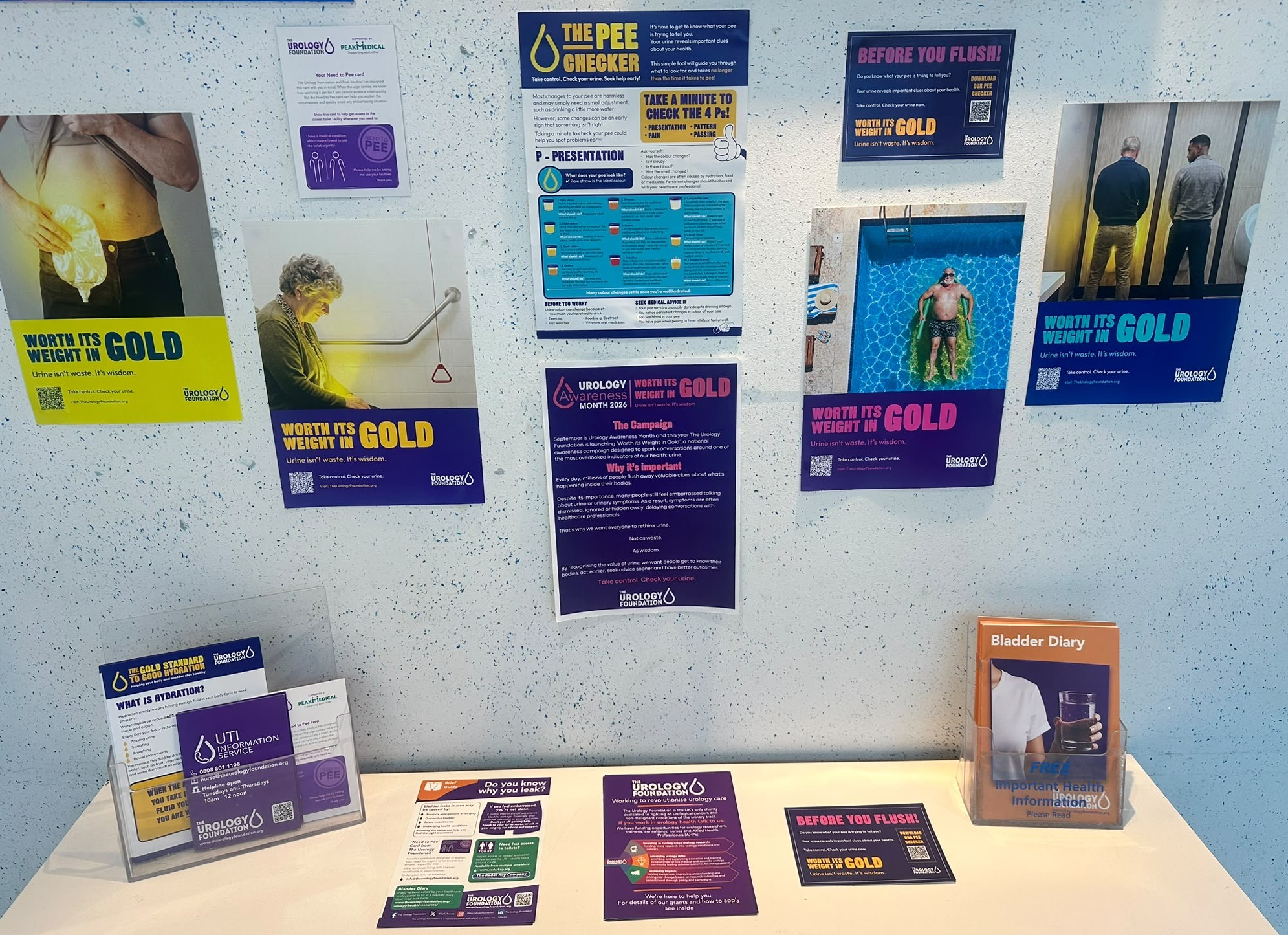
Every day, millions of people flush away valuable clues about what's happening inside their bodies.
Despite its value and importance, people still feel embarassed talking about toileting. This can result in symptoms being dismissed, ignored or hidden, and conversations with Healthcare professionals (HCPs) being delayed. People who act earlier and seek advice sooner, have better otucomes.
Hydration is an important part of Urology discussions - the word itself simply means having enough fluid in your body for it and your bladder to work properly and at their best, especially as water makes up approx. 60% of an adult's body; it is essential for every cell, tissue and organ. Every day, your body naturally loses fluid through things like toileting, sweating and breathing. You replace this by drinking, and eating foods that naturally contain water (i.e. fuit, vegetables, water-rich foods (e.g. soups, broths, some dairy (such as yoghurts and plant based alternates))) - when the amount of fluid you take in replaces the amount your body loses, you're well hydrated. By staying well hydrated, you support every system in your body and do things such as:
- support healthy kidney & bladder function;
- reduce the risk of 'urinary tract infections (UTIs)' by encouraging regular toileting;
- support concentration / memory / mental alertness;
- maintain energy levels & reduce tiredness;
- prevent constipation;
- regulate body temperature; and
- carry nutrients around the body & support normal bodily functions.
Some people drink fluids containing 'electrolytes' - these are minerals (salts) such as sodium, potassium, calcium and magnesium, that help your body keep the right balance of water and support normal muscle & nerve function. A healthy balanced diet for most people will provide all the electrolytes needed, further fluids containing these are not required. However, electrolytes can be helpful after prolonged periods of exercise (normally more than one hour), episodes of heavy sweating, or illness causing sickness & diarrhoea - they help reduce the fluids & salts that your body has lost.
Water is usually the best choice for everyday hydration, however hydration doesn't just come from drinking water, you don't need to drink water alone to stay hydrated - most drinks (e.g. milk, tea, coffee, sugar-free drinks), along with many fruits (e.g. watermelon, berries, oranges), vegetables (e.g. cucumber, tomatoes, lettuce) & other water-rich foods (e.g. soups, broths, stews), all contribute to your daily fluid intake. It is a myth that tea & coffee dehydrate you, if drank in moderate quantities - however, the caffeine they contain may irritate the bladder. Alcohol is not a good choice for hydration because it can increase fluid loss and contribute to dehydration, especially if you drink it in large quantities. If you do choose to drink alcohol, it is recommended to alternate it with water. If you have drunk alcohol, drinking water before bedtime can help reduce dehydration.
There isn't one perfect amount of fluid for everyone, but most adults should aim to drink approx. 1.5 to 2 litres per day (drinking excessive amounts doesn't provide extra health benefits and can actually be harmful on occasion). The amount you need depends on things such as: age, activity levels, the weather, if you're unwell (such as having a fever, or are experiencing sickness & diarrhoea), general health, and, if you're female, if you're pregnant or breastfeeding.
Some people are more susceptible to dehydration:
- older adults - the sensation of thirst diminishes with age, so you may not feel thirsty, even if your body needs fluid;
- those using urinary catheters - staying well hydrated helps liquid flow through the catheter and can reduce problems, such as catheter blockages; and
- those living with dementia - carers should offer these people fluids on a regular basis.
However, it's important to note that those who have been advised to reduce their fluid intake (such as those suffering from heart failure, advanced kidney disease etc.) should continue to follow their HCPs' advice.
To stay hydrated, it is recommended that you drink regularly throughout the day, rather than waiting until you're thirsty. A simple way to check if you're well hydrated is to check the colour of your urine - you should aim for a pale, straw-colour (rather than completely colourless). The Urology Foundation (a medical research charity dedicated to improving the lives of those affected by a Urological condition) has a useful 'Pee Checker' with more info..
If you use a self catheter, completing a three day in a row bladder diary can help you understand more about what's happening to your bladder. It can help you spot patterns / triggers, choose the right treatment, and help you feel more in control. For the most accurate diary, include day & night time, but don't worry if you miss something, just fill in as much as you can. To complete a diary, firstly, you need a measuring jug, available from most supermarkets, with a measure in millilitres (ml). Then you need to:
- measure everything you drink in quantity and type (e.g. if you had a cup of tea, you should write down: "one 284ml cup of caffeinated tea");
- record when and how much you pass urine with your self catheter (e.g. 10.00am 100ml)
- (if you experience a urine leak, write down LEAK);
- (if you use pads, write down when you needed to change them);
- write down how your bladder felt each time you passed urine (use the following scale: 1 = normal desire to pass urine without the feeling of urgency; 2 = you had the feeling of urgency but it passed before you passed urine; 3 = you had the feeling of urgency and managed to get to the toilet in time without leaking; 4 = you had the feeling of urgency and had a leak before you were able to get to the toilet);
- record what time you woke up and what time you went to bed; and
- any other notes (e.g. if you had pain / what task you were undertaking etc.).
Then, take your completed diary to your next Urology clinic appointment.
September 2026 was Urology Awareness month - Too many people put off seeking help because conversations about urine and urinary symptoms feel uncomfortable. #WorthItsWeightInGold ⚖️ is changing that. By talking openly, breaking taboos and encouraging earlier action, more people can get the support they need sooner. 📲 Download The Pee Checker and make a change today - www.theurologyfoundation.org/app/uploads/2026/08/The-PeeChecker.pdf Take control. Check your urine. #UrologyAwarenessMonth #UAM26
The surgery have produced a display in the waiting room, highlighting the above Urology Awareness info.: